Showing posts with label General Motors. Show all posts

Sunday, August 7, 2011

Vauxhall

Vauxhall

Vauxhall | Car Review | Vauxhall or Vauxhall Motors or Vauxhall Motors Ltd is a company name ofBritish automobile manufacturer owned by GM, General Motors.  Vauxhall Motors Ltd is headquartered in Luton, United Kingdom.

Vauxhall
Vauxhall Astra, 2010

Vauxhall was founded in 1857 as a pump and marine engine manufacturer, began manufacturing cars in 1903 and was acquired by GM in 1925. It has been the second-largest selling car brand in the UK for over two decades. The current Vauxhall range includes :Agila (city car), Astra (small family car), Corsa (supermini), Insignia (large family car), Meriva (mini MPV) and Zafira (compact MPV).

Vauxhall
Vauxhall VXR8 Interior, 2011

Vauxhall
has major manufacturing facilities in Luton (commercial vehicles) and Ellesmere Port, UK (passenger cars). The Luton plant currently employs around 1,170 staff and has a capacity of approximately 100,000 units. The Ellesmere Port plant currently employs around 2,100 staff and has a capacity of approximately 187,000 units.

Vauxhall
Vauxhall Ampera, 2011

The Vauxhall product range is largely identical to that of Opel, GM's German subsidiary, and most models are principally designed in Rüsselsheim, Germany. A high proportion of Vauxhall-branded vehicles sold in the UK are produced at Opel factories in Germany, Spain and Poland, and roughly 80% of Vauxhall production is exported, most of which is sold under the Opel brand.

Vauxhall
Vauxhall Corsa, 2011

The griffin emblem, which is still in use, is derived from the coat of arms of Falkes de Breauté, a mercenary soldier who was granted the Manor of Luton for services to King John in the thirteenth century. By marriage, he also gained the rights to an area near London, south of the Thames. The house he built, Fulk's Hall, became known in time as Vauxhall. Vauxhall Iron Works adopted this emblem from the coat of arms to emphasise its links to the local area. When Vauxhall Iron Works moved to Luton in 1905, the griffin emblem coincidentally returned to its ancestral home.

Vauxhall
Vauxhall Zavira, 2011

Alexander Wilson founded the company in the Dusian Road, Vauxhall, London in 1857. Originally named Alex Wilson and Company, then Vauxhall Iron Works, the company built pumps and marine engines. In 1903, the company built its first car, a five-horsepower model steered using a tiller, with two forward gears and no reverse gear. This led to a better design which was made available for sale.

Vauxhall
Vauxhall Astra VXR, 2005

In 1903, the first ever Vauxhall car was the 6HP with its slow-revving single cylinder engine and a chassis that was Forward Thinking – amalgamating the chassis and lower body into a composite steel and wood structure. Vauxhall’s sporting debut also came in October 1903 with a time trail in the ninth Vauxhall ever made.
Vauxhall

To expand, the company moved the majority of its production to Luton in 1905. The company continued to trade under the name Vauxhall Iron Works until 1907, when the modern name of Vauxhall Motors was adopted. The company was characterised by its sporting models, but after World War I the company's designs were more austere.

Vauxhall
Vauxhall Cavalier, 1980

In 1908, the A-type grew out of the Y-type prototype that beat Rolls Royce on a 200 mile speed test at the newly opened Brooklands track, laying more foundations for a dynasty of sporting Vauxhalls. The A-type sported a wide range of formal, touring and sporting coachwork. In 1910, The Prince Henry, with its distinctive pointed radiator was the most famous Edwardian Vauxhall of all, enjoyed by wealthy customers who regarded sporting motoring as something of an adventure coupled with an interest in new technology.

Vauxhall
Vauxhall Cresta PA, 1960

In 1922, Luton wanted out and out racing cars to compete in ever more competitive events. The 1922 TT Vauxhall was all that and more. A 3.0 litre racing car with engines by design legend H R Ricardo. Two overhead camshafts with four valves per cylinder, roller big ends in an aluminium block with wet sump lubrication pointed the way forward.

Vauxhall
Vauxhall Velox Series L, 1950

With its overhead valve engine, in 1923, the Vauxhall E-type 30-98 became the fastest catalogued car in Britain. Bodies included an elegant 4-seat Velox open tourer and a dramatic nautical-looking ‘boat-tailed’ Wensum with polished wood panelling.
Vauxhall
Vauxhall, 1929

In 1925, General Motors buys Vauxhall for $2.5 million in a deal encouraged by GM President Alfred P Sloan Jnr. The first Vauxhall made under GM was a short wheelbase 21HP model. - CAR REVIEW

Vauxhall

Wednesday, August 3, 2011

Buick

buick

CAR REVIEW | Buick | Buick is a luxury brand of car produced by General Motors (GM). Buick car  models are sold in the United States, Canada, Israel, Mexico, China, and Taiwan, with China being its largest market. Buick holds the distinction as the oldest active American make. Some current Buick models are shared with GM's German Opel subsidiary.

buick-lacrosse
Buick Lacrose

The Buick is currently the oldest American still-active automotive make, and among the oldest automobile brands in the world. It originated as the Buick Auto-Vim and Power Company in 1899, an independent internal combustion engine and motor-car manufacturer, and was later incorporated as the Buick Motor Company on May 19, 1903, by Scottish born David Dunbar Buick in Detroit, Michigan. Later that year, the struggling company was taken over by James H. Whiting (1842–1919), who moved it to his hometown of Flint, Michigan, and brought in William C. Durant in 1904 to manage his new acquisition. Buick sold his stock for a small sum upon departure, and died in modest circumstances twenty-five years later.
1912 Buick logo

Between 1899 and 1902 two prototype vehicles of Buick were built in Detroit, Michigan by Walter Lorenzo Marr. Some documentation exists of the 1901 or 1902 prototype with tiller steering similar to the Oldsmobile Curved Dash.

Buick-Enclave
Buick Enclave, 2010

In mid-1904 another prototype was constructed for an endurance run, which convinced James H. Whiting to authorize production of the first models offered to the public. The architecture of this prototype was the basis for the Model B.

The first Buick made for sale, the 1904 Model B, was built in Flint, Michigan. There were 37 Buicks made that year, none of which survived. There are, however, two replicas in existence: the 1904 endurance car, at the Buick Gallery & Research Center in Flint, and a Model B assembled by an enthusiast in California for the division's 100th anniversary. Both of these vehicles use various parts from Buicks of that early era, as well as fabricated parts. These vehicles were each constructed with the two known surviving 1904 engines.

Buick_Eight_Sedan-1951
Buick Eight Sedan, 1951

The power-train and chassis architecture introduced on the Model B was continued through the 1909 Model F. The early success of Buick is attributed in part to the valve-in-head engine patented by Eugene Richard. The creation of General Motors is attributed in part to the success of Buick, so it can be said Marr and Richard's designs directly led to GM.

The basic design of the 1904 Buick was optimally engineered even by today's standards. The flat-twin engine is inherently balanced, with torque presented to the chassis in a longitudinal manner, actually cancelling front end lift, rather than producing undesirable lateral motion. The engine was mounted amidships, now considered the optimal location.

buick
Buick 2011

Durant was a natural promoter, and Buick soon became the largest car maker in America. Using the profits from this, Durant embarked on a series of corporate acquisitions, calling the new mega-corporation General Motors. At first, the manufacturers comprising General Motors competed against each other, but Durant ended that. He wanted each General Motors division to target one class of buyer, and in his new scheme Buick was near the top — only the Cadillac brand had more prestige. This is the position that Buick occupies to this day in the General Motors lineup. The ideal Buick customer is comfortably well off, possibly not quite rich enough to afford a Cadillac, nor desiring the ostentation of one, but definitely in the market for a car above the norm.

At first, Buick followed the likes of Napier in automobile racing, winning the first-ever race held at Indianapolis Motor Speedway.

buick
Buick 1931

Buick launched its first closed-body car in 1911, four years ahead of Ford. As part of General Motors' companion make program, in 1929 Buick Motor Division launched the Marquette sister brand, designed to bridge the price gap between Buick and Oldsmobile; but, Marquette was stopped in 1930. Buick recorded another first, when it became the first company to introduce turn signals in 1939. - Car Review

Buick

Thursday, July 28, 2011

Pontiac GTO


Pontiac GTO | Car Review | The Pontiac GTO is a car built by the Pontiac division of General Motors in the United States from 1964 to 1974 and by GM subsidiary Holden in Australia from 2004 to 2006. It is considered an innovative, classic muscle car of the 1960s and 1970s. From 1964 to mid 1973, it was closely linked to Pontiac Tempest / Le Mans and the 1974 model year it was based on the Pontiac Ventura. The 21st century GTO is essentially a left hand drive Holden Monaro, itself a variant of the Holden Commodore coupe.


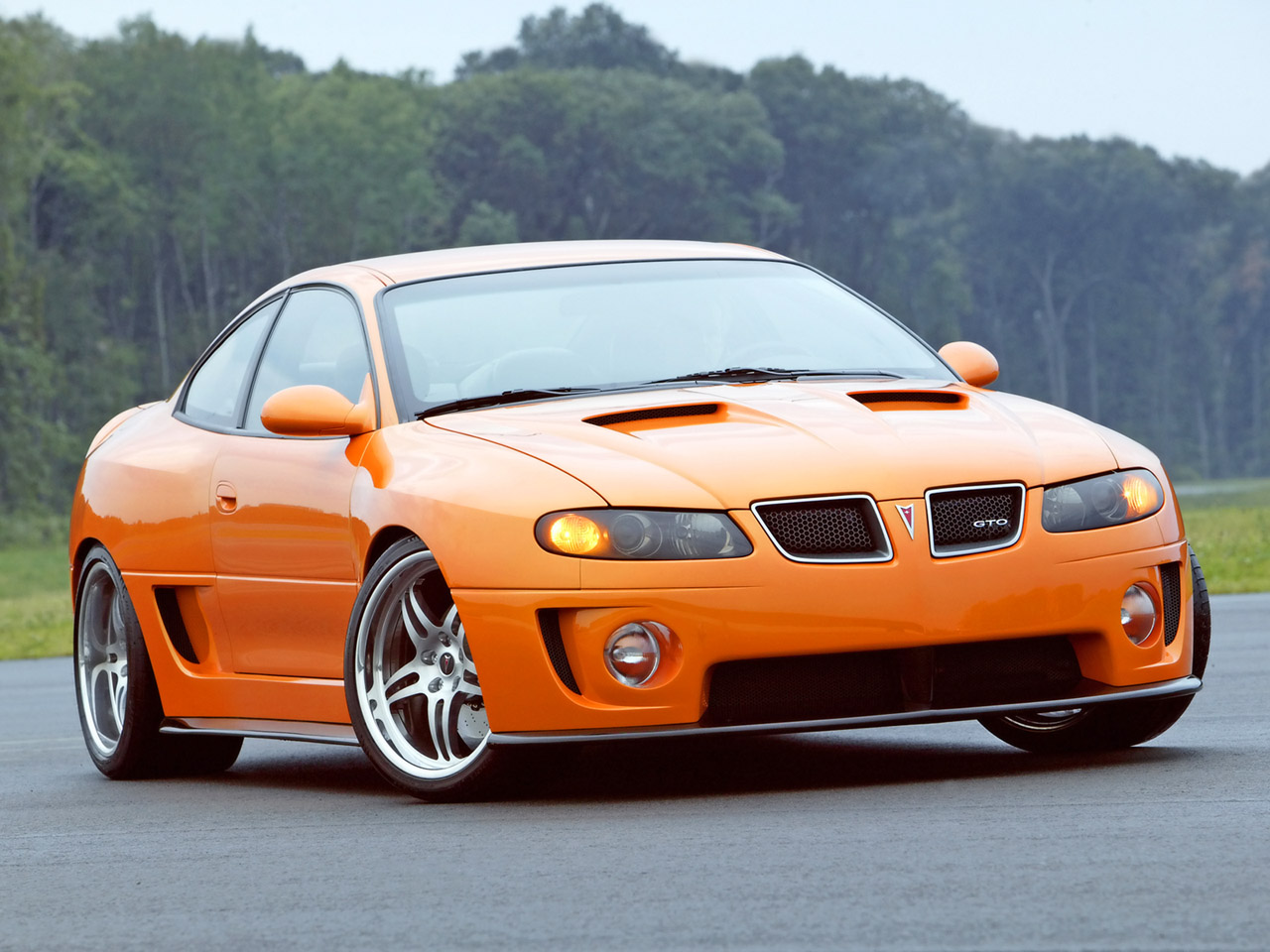
Pontiac GTO Ram Air 6, 2004

Pontiac GTO was the brainchild of Pontiac engineer Russell Gee, an engine specialist; Bill Collins, a chassis engineer; and Pontiac chief engineer John DeLorean. In early 1963, General Motors' management issued an edict banning divisions from involvement in auto racing. At the time, Pontiac's advertising and marketing approach was heavily based on performance, and racing was an important component of that strategy. With GM's ban on factory-sponsored racing, Pontiac's young, visionary management turned its attention to emphasizing street performance.

Pontiac GTO 1974

In his autobiography “Glory Days,” Pontiac chief marketing manager Jim Wangers, who worked for the division’s contract advertising and public relations agency, states that John DeLorean, Bill Collins and Russ Gee were indeed responsible for the GTO's creation. It involved transforming the upcoming redesigned Tempest (which was set to revert to a conventional front-engine, front transmission, rear-wheel drive configuration) into a "Super Tempest" with the larger 389 cu in (6.4 L) Pontiac V8 engine from the full-sized Pontiac Catalina and Bonneville in place of the standard 326 cu in (5.3 L) Tempest V8. By promoting the big-engine Tempest as a special high-performance model, they could appeal to the speed-minded youth market (which had also been recognized by Ford Motor Company's Lee Iacocca, who was at that time preparing the Ford Mustang).

Pontiac GTO 1973

The name, which was DeLorean's idea, was inspired by the Ferrari 250 GTO, the successful race car. It is an Italian abbreviation for Gran Turismo Omologato, (exact translation is Grand Tourer Homologated) which means officially certified for racing in the Grand tourer class. The name drew protest from purists, who considered it close to sacrilege.

Pontiac GTO 1969

Pontiac GTO was essentially a violation of GM policy limiting the intermediary a line to a maximum displacement of 330 cubic inches (5.4 L). Since the GTO was an option package and no series could be considered to fall into a gap in politics. Pontiac General Manager Elliot "Pete" Estes has approved the new model, although sales manager Frank Bridge, who did not believe it would find a market, insisted on limiting initial production to no more than 5000 cars. If the model is a failure, Estes probably would have been reprimanded. As it turned out, was a great success. - CAR REVIEW

Pontiac GTO Convertible 1965

Pontiac GTO

Tuesday, March 15, 2011

About Chevrolet Aveo T250

GM introduced a revised sedan at Auto Shanghai 2005, designed in cooperation with PATAC. Bearing the internal code T250 and sold in South Korea as the "Daewoo Gentra", the revision comprised primarily interior and exterior styling changes, a new interior instrument panel and minor equipment changes, including increased sound deadening. Incorporation of the radio antenna into the rear glass and extensive wind tunnel testing helped reduce the coefficient of drag from 0.348 to 0.326.

A restyled hatchback with the sedan's updated instrument panel was presented as the Chevrolet Aveo during the Frankfurt Motor Show 2007, to be marketed in Europe and North America. The Korean market received its own distinct restyle of the hatchback, the Gentra X.

Later iterations, including the Kalos, Aveo, Barina and Gentra sedans, the Gentra X hatchback and the 2007 "Frankfurt Show" hatchbacks were styled in-house and with the assistance of PATAC, and depart notably from the original Giugiaro exterior and interior styling designs.

With launch of the Gentra X in South Korea, GMDAT had replaced engines of T250. 1.2 L S-TEC II inline-four engine was updated with features such as dual overhead camshaft (DOHC) and timing chain (older version has timing belt) system. 1.6 L E-TEC II engine had replaced with ECOTEC (GEN-III) engine with new features such as variable valve timing mechanism.

Saturday, March 12, 2011

Design Development of Chevrolet Aveo T200

Chevrolet Aveo T200
Daewoo's now disbanded Worthing Technical Centre in the UK conducted the initial research and platform engineering, with Daewoo's main Technical Center in Bupyong, Incheon, South Korea completing the majority of the later development programme. Daewoo engineers refined the chassis in Britain, on the proving ground at Motor Industry Research Association near Nuneaton, UK. Long-term testing covered nearly 2.2 million kilometers (1.4 million miles) with further testing outside South Korea on test sites in Arjeplog, Sweden; Granada and El Vendrell, Spain; Kapuskasing, Canada and Beijing, China. According to an April, 2003 GMDAT press release, Daewoo built 119 prototypes during the Kalos's design and development, crashing 31 for research and data-gathering purposes, and manufacturing 39 pilot production vehicles to verify standards and quality.

The body's sheet metal panel gaps were kept to 3 mm (0.1 in) and all but the roof panel were galvanized steel. 46% of the Kalos' underlying structural components were produced with high-strength steel, with tailor-welded blanks used in the production of the vehicle to put strength where needed while saving weight. The front suspension used MacPherson struts with offset coil springs and a stabilizer bar, while the rear featured a semi-independent torsion beam axle.

The body featured a drag coefficient of 0.35, with a frontal area of 2.16 m2 (23.3 sq ft) giving aerodynamic resistance of 00.74 m2 (8.0 sq ft). All Kalos iterations featured high H-point seating within a relatively narrow, short and high-roofed body that combined a long wheelbase with short front (81 cm/32 in) and rear (49 cm/19 in, hatchback) overhangs to maximize the outward visibility, interior space and maneuverability relative to the vehicle's footprint. Rear seat H-points are higher in all body types, giving the car theatre seating.

About Chevrolet Aveo

The first generation of Chevrolet Aveo began with launching Model T200, a subcompact automobile which has manufactured and marketed since 2002 by GM Daewoo, the South Korean subsidiary of General Motors. The model was marketed prominently under the nameplate Aveo. The model received the T200 internal codes, used first by Daewoo, and then, by GM Daewoo during the car's development. The T250 code was designated for the facelifted models.

Chevrolet Aveo T250 (sedan)
Designed, engineered and originally marketed by GM Daewoo, the Aveo succeeded the Daewoo Lanos and was marketed worldwide in 120 countries under five brands: Chevrolet, Daewoo, Holden, Pontiac, and Suzuki, being originally called Daewoo Kalos in its home country market South Korea, before being rebranded Daewoo Gentra. In other markets, the first generation model was marketed as the Holden Barina in Australia and Asia, Pontiac G3 in the United States and later Canada, previously in Canada as the Pontiac Wave and currently in Canada as the Suzuki Swift+. The successor of T200, the Chevrolet Aveo T300 will be released in 2011.

Tuesday, September 28, 2010

General Motors to Sell a Diesel Powered Car in North America

I hope that if this car actually comes about that it is a success, then maybe companies like Honda can bring their diesel products over here to North America....
General Motors has confirmed that it will sell a diesel-powered car on U.S. soil in the future. According to Ward’s Auto, the source of the news is none-other than GM Vice Chairman Tom Stephens. The use of a diesel would mark the first time in almost three decades that a diesel car was sold in the U.S., with the last diesels being sold in Cadillac, Buick and Oldsmobile vehicles in the late ’70s and early ’80s.

There’s no additional info on what vehicle could get the new diesel powerplant or even if the diesel engine being considered is new. GM has been offering a diesel version of its Ecotec 4-cylinder in Europe and other markets since 1996. That being said, it would seem easiest to offer a diesel engine in a car like the Buick Regal, which is based off the European Opel Insignia and is already offered with a choice of several diesel powerplants overseas including an upcoming twin-turbo 2.0-liter CDTi Ecotec motor making 190-hp and 300 ft-lbs of torque.

Source;
http://www.autoguide.com/auto-news/2010/09/general-motors-to-sell-a-diesel-powered-car-in-north-america.html

Thursday, April 22, 2010

GM pays back government loans in full

Here's a bit of good news....
Kansas City, Kansas – General Motors has made its final payment of US$5.8 billion to the U.S. Treasury and Export Development Canada, paying back its government loans in full and ahead of schedule. The payment includes $4.7 billion to the U.S. Treasury, and $1.1 billion to Export Development Canada.

The announcement was made by GM chairman and CEO Ed Whitacre at a ceremony in Fairfax, Kansas to announce an investment of $257 million in Fairfax and Detroit Hamtramck assembly centres. The investment will prepare Fairfax to build the next-generation Chevrolet Malibu and make Detroit Hamtramck a second source for the model. Fairfax currently builds the current Malibu and the Buick LaCrosse.

As part of the launch of the new GM, the U.S., Canadian and Ontario governments provided loans of $8.4 billion and took equity stakes in the new company. The latest payment completes the payback of the loans.

“GM’s ability to pay back the loans ahead of schedule is a sign that our plan is working, and that we are on the right track,” Whitacre said. “It is also an important first step toward allowing our stockholders to reduce their equity investments in GM. We still have much hard work ahead of us, but we are making progress toward our vision of designing, building and selling the world’s best vehicles. We appreciate the support the taxpayers have given GM, and our new great products are tangible results of that support.”

Source;
http://www.canadiandriver.com/2010/04/21/gm-pays-back-government-loans-in-full.htm

Friday, December 18, 2009

GM lets Saab die

First Saturn, then Pontiac, now SAAB....
NEW YORK (CNNMoney.com) -- General Motors is shutting down its Swedish car brand, Saab, after attempts to close a deal with a buyer failed.

GM had announced earlier this year that it was close to reaching a deal with Swedish super-carmaker Koenigsegg. That deal fell, though.

"In the end, Koenigsegg discovered some issues they didn't think could be overcome in a timely fashion," said John Smith, GM vice president of corporate planning and alliances.

Dutch exotic carmaker Spyker then emerged as a bidder for Saab, but that deal couldn't be concluded in time, GM said.

In both cases, according to GM, issues arose during negotiations that prevented a final sale. GM executives would not say what the specific problems were, however.

"Like everybody, we would have preferred a different outcome," Smith said.

GM said it still intends to sell some Saab 9-3 and 9-5 technologies to the Chinese automaker Beijing Automotive Industry Holdings Co. Ltd. That deal was announced last week.

With GM's announcement that it's winding down Saab, BAIC or other companies may be able to buy more of Saab's assets, possibly even the brand name itself, Smith said. But no buyers have expressed interest, yet.

Brands we loved ... and lost in 2009

"Despite the best efforts of all involved, it has become very clear that the due diligence required to complete this complex transaction could not be executed in a reasonable time. In order to maintain operations, Saab needed a quick resolution," said GM Europe President Nick Reilly.

"We regret that we were not able to complete this transaction with Spyker Cars."

GM has owned the Swedish automaker since 1989; Saab has been making cars since 1949. GM will now begin winding down Saab production, but warranties will continue to be honored, and spare parts will still be available, the company said.

In the past two decades, GM has made every effort to turn Saab into a profitable car brand, Smith said. But recent global economic problems were simply too much for the still-weak automaker to survive.

"It's a business that has struggled more years than not during its existence," Smith said.
A total of 3,400 employees will be directly affected by Saab's closure, GM spokesman Chris Pruess said.

Saab has never been a big-selling car brand, but the recent global recession and news of the brand's possible demise have driven sales down to crisis levels. Saab's U.S. sales have been down by more than half so far this year.Sweden's other major automaker, Volvo, is currently owned by Ford, which is in the process of selling it to the Chinese automaker Geely.

As part of its bankruptcy restructuring, GM planned to sell of or wind down four of the eight brands it recently operated. Pontiac is being wound down; a deal to sell the Saturn brand to Penske Automotive fell through in September; and a deal to sell the Hummer SUV brand to Chinese heavy equipment maker Sichuan Tengzhong is awaiting government approvals.

GM's remaining brands are Chevrolet, Buick, GMC and Cadillac.

Source;
http://money.cnn.com/2009/12/18/autos/saab_closed/

Monday, December 7, 2009

BusinessWeek: The Battle Raging Inside GM

Henderson's ouster leaves Whitacre and the board of mostly Detroit outsiders calling the shots. And that's making GM's executives jittery

By David Welch
The Dec.1 ouster of Frederick A. "Fritz" Henderson as General Motors' CEO was a surprise, but only in how fast it happened. Since GM emerged from bankruptcy in September, Chairman Edward Whitacre Jr. had become the de facto chief executive, and his board had reversed one of Henderson's biggest decisions. Now, as Whitacre looks for a new CEO (assuming he doesn't take the job himself), he and the directors are in the driver's seat. Whitacre and much of the board are industry outsiders. Now GM veterans are asking: Do they know what they're doing?

Dumping Henderson made tactical sense. He was a GM lifer and restructuring expert running a company that now needs a strategic visionary with expertise in reaching consumers. But firing and replacing him with Whitacre, at least on an interim basis, is risky. He will have to make big calls: how to fix the European business, burnish GM's brands, choose new vehicles, and build a management team. None of it will be easy for a former telecom guy who told employees on Dec.2 that he doesn't even know where his office is. "Now Whitacre is on the hot seat," says James N. Hall, principal of 2953 Analytics, a Detroit-area consulting firm. "He has to listen, trust the leadership team, and filter out GM's autoimmune system." (GM declined to comment.)

Nervous Executives
One of Whitacre's big challenges will be motivating a jittery staff. Right after Henderson's firing, Whitacre held a conference call with GM's top executives. Some asked if he wanted their resignations, too. Whitacre tried to assuage their concerns. "He was clear that we have good people," says an executive who was on the call. "He said: 'I can't do this without you.' "

But Whitacre's soothing words are cold comfort. He told Bloomberg News in mid-November that Henderson had the board's confidence. Two weeks later Henderson was gone. Several GM executives say the uncertainty is hurting morale. "It's almost like experience is a liability these days," one says.

Already, some top executives are getting antsy. Sources close to Vice-Chairman Robert A. Lutz say he is dismayed at Henderson's firing. The 77-year-old executive doesn't like how it was handled and has told people close to him he is not even sure what his role will be. If Lutz were to leave, GM would lose the one guy who has managed to bypass GM's sclerotic culture and build cars people will actually pay decent money for. "Is this the time to blow the whole thing up again?" wonders Joseph Phillippi, a veteran GM watcher and principal of Auto Trends, a New Jersey consulting firm.

While Whitacre looks for Henderson's replacement, GM's new hyper-independent board will be calling the shots. It's far from clear that the directors have made the right decisions so far. Particularly worrisome to GM veterans are the actions of private equity executives Steve Girsky, David Bonderman, and Daniel Akerson. All three were tough on Henderson in board meetings, say executives briefed on the discussions. They pushed Henderson to keep GM's German unit Opel rather than sell it. GM has long needed an independent board, but GM insiders fear that too much second-guessing could prevent the company from sticking to a clear strategy. (The three directors couldn't be reached for comment.)

The Opel Reversal
The decision to keep Opel was divisive. The board thought it too risky to cede control of GM's European engineering works, where the company designs its small and midsize cars. Plus, GM would lose up to 1.5million cars a year in sales. But holding on to the subsidiary is risky, too. Opel hasn't made money in a decade and is in the throes of restructuring. Finishing the job will cost GM some $3billion and divert executive focus from the troubled North American business and expanding operations in Asia and Latin America.

As Whitacre steers GM in the interim, he may learn a few lessons. He wants GM to push market share above 20% next year from 19.7% today. But as GM phases out Hummer, Pontiac, Saab, and Saturn, the carmaker will lose more buyers. What's more, Whitacre wants GM to expand market share with lower discounts. That's a prudent goal, but people don't rush to buy damaged brands for no reason. While GM's November sales fell just 1.5%, the company outspent its rivals on incentives by at least $1,000 a car, blowing $4,300 per vehicle, says Edmunds.com. If Whitacre pulls back too much on the discounts, sales could plummet.

As for Henderson's replacement, Whitacre and the board want a non-GM person or an industry outsider such as Alan Mulally, who left Boeing (BA) and has since managed to bring Ford Motor (F) back from the brink. But potential candidates will have to consider two facts of life: an activist chairman and board and a salary that GM's government minders have capped at $1million. "It's a sick company with a bad ownership structure and pay constraints," says Charles Elson, director of the John L. Weinberg Center for Corporate Governance at the University of Delaware. "I don't know who they will get." The only person willing to report to Ed Whitacre may wind up being—that's right—Ed Whitacre.

Welch is BusinessWeek's Detroit bureau chief.

Source;
http://www.businessweek.com/magazine/content/09_50/b4159000314215.htm?chan=autos_autos+--+lifestyle+subindex+page_top+stories

Friday, October 10, 2008

GM, Ford May Face Bankruptcy on Slowdown, S&P Says

Well, these are some pretty intense times with how the stock market has taken a tumble, leading the way is GM and FORD. Times have not been good to either company and it is heavily reflected in how the economy has gone. A healthy domestic car sector is a healthy economy. Let's hope they can turn it around.
Oct. 10 (Bloomberg) -- General Motors Corp., Ford Motor Co. and Chrysler LLC may be forced into bankruptcy by slowing economies and dwindling U.S. auto sales, Standard & Poor's analyst Robert Schulz said.

"Macro factors could overwhelm them at some point'' even as the three biggest U.S. automakers vow to stick with their turnaround plans, Schulz, S&P's lead automotive credit analyst, said today in a Bloomberg Television interview in New York. The companies said they have no plans for a bankruptcy filing.

His assessment underscored the pressure on GM, Ford and Chrysler as the worsening global credit crisis makes it harder for buyers to get loans and dealers to finance their operations. S&P said yesterday it may further trim credit ratings for GM and Ford on forecasts for 2009 auto demand falling to the lowest level since 1992.

With all three companies working to boost cash, any bankruptcy filing would be a last resort, not a "strategic'' decision, Schulz said.

"We don't see that as something they would choose,'' he said. Schulz said the "trigger'' for a forced restructuring under bankruptcy protection would be based on the automakers' ability to preserve liquidity as sales decline. Industrywide U.S. sales slid 27 percent last month, the most in 17 years.

'Not an Option'

"Bankruptcy is not an option GM is considering,'' spokeswoman Renee Rashid-Merem said yesterday. "It would not be in the interests of our employees, stockholders, suppliers or customers.''

Ford and Chrysler also have said they're not considering bankruptcy.

GM rose 7 cents, or 1.5 percent, to $4.83 at 1:40 p.m. in New York Stock Exchange composite trading, while Ford dropped 8 cents to $2. GM slumped to a 58-year low yesterday and Ford closed at its lowest since 1982. Chrysler is closely held.

Operating-cash needs at GM, Ford and Chrysler are "substantial, so if it looked like they were going to be pushing toward that number because of these operating losses and cash usage, that's sort of the point where they'd have to consider'' bankruptcy, Schulz said.

S&P said yesterday that its debt ratings for GM and Ford, already at six steps below investment grade at B-, may be lowered again because the automakers face a "serious challenge'' in 2009.

Barclays Capital reduced its target stock price for GM to $4 today, with analyst Brian Johnson in Chicago citing dwindling global auto demand.

GM's Cash Needs

"With auto sales stalled in the U.S. and beginning to contract in the rest of the world, we believe GM's cash needs are increasing,'' Johnson wrote in a note. "Moreover, the downside risk of greater decline in worldwide auto sales driving greater cash needs is increasing."

GM and Dearborn, Michigan-based Ford lost a combined $24.1 billion last quarter. GM last posted an annual profit in 2004, while Ford hasn't had a full-year profit since 2005.

GM's Rashid-Merem said the automaker still expects to add $15 billion in liquidity by the end of next year, including speeding up plans to cut $10 billion in costs.

Ford has a cash cushion, spokesman Mark Truby said yesterday in response to S&P's report raising the prospect of another ratings cut.

Ford's Borrowing

"We were fortunate to go to the markets at the right time,'' Truby said, referring to $23.4 billion borrowed in late 2006 to help pay for shutting plants and cutting jobs while developing new models.

He said Ford is reviewing its liquidity and will give an update when third-quarter financial results are released. Ford hasn't given a date for the release, which the company typically issues later in October.

Chrysler has no plans to declare bankruptcy, spokeswoman Shawn Morgan said yesterday in an interview.

The automakers won Congress's approval last month for funding a $25 billion loan package to help develop more fuel- efficient vehicles. Those funds will be spread primarily among Ford, GM and Auburn Hills, Michigan-based Chrysler, though other automakers, such as Volkswagen AG, have said they will seek a portion.

Regulators are writing the rules for that borrowing even as auto-market conditions worsen. Industry researcher J.D. Power & Associates estimated yesterday that U.S. industrywide sales will fall to 13.6 million this year and 13.2 million in 2009. Last year's total was 16.1 million.

Industrywide Outlook

Industrywide sales of 13 million autos next year would mean shrinkage in the overall U.S. vehicle fleet, said Erich Merkle, an analyst for consulting firm Crowe Horwath LLP in Oak Brook, Illinois.

"We are going to find people where they may have had three cars and now have two, and two cars now have one, and a lot of that is just because of the economic environment,'' Merkle said. "They may not have the ability to buy a new car and even if they do, they may not be able to get financing for that car.''

Global demand in 2009 may be even worse, with "an outright collapse'' now possible, according to J.D. Power, which is based in Westlake Village, California.

GM may announce further production cuts or plant closures as early as next week, the Associated Press reported today. GM spokesman Tony Sapienza declined to comment on the report in an interview.

In July, GM said it was considering further cuts to its metal stamping and engine plants because of reduced U.S. sales.

GM's 8.375 percent note due July 2033 fell 5.5 cents to 19 cents on the dollar today, yielding 43.9 percent, according to Trace, the bond-price reporting system of the Financial Industry Regulatory Authority.

Ford's 7.45 percent note due July 2031 declined 12 cents to 22 cents on the dollar, yielding 33.8 percent.

To contact the reporters on this story: Jeff Green in Southfield, Michigan, at jgreen16@bloomberg.net; Greg Bensinger in New York at gbensinger1@bloomberg.net


Below each logo is a link to the ticker for each company's stock quote in US funds.

Source;